
Furnace and Boiler Repair in Cleveland
How furnace and boiler faults get traced to the failed part and fixed, and what to check before you book.
Gas furnaces tend to fail in a few familiar ways. The igniter cracks, the flame sensor coats over, the pressure switch won’t close or the blower capacitor weakens, and the furnace either never lights or lights and shuts down a minute later. Electric furnaces have fewer parts but faults of their own: burned-out heating elements, failed sequencers and tripped limit switches. Each repair visit starts by finding the part that actually failed, and the repair is that part.
How a Gas Furnace Lights
Every call for heat runs the same sequence, and a fault shows up where the sequence stops:
- The thermostat closes the heat circuit and the control board starts the inducer motor.
- The pressure switch proves the vent is drawing and closes.
- The hot-surface igniter glows, the gas valve opens and the burners light.
- The flame sensor proves the flame within a few seconds, or the board shuts off the gas and tries again.
- After a short delay the blower starts, while the limit switch watches for overheating.
Most control boards blink a fault code through a small window in the blower door. Write down the pattern before you turn the power off, because cutting the power clears it.
Common Heating Problems
| Symptom | Likely cause | Can the homeowner check it | When to book a technician |
|---|---|---|---|
| Blower runs but the air is cold | Burners not lighting: a cracked igniter, a gas valve that won’t open or a tripped high limit | Yes: thermostat on Heat, not Fan On, and the gas valve handle in line with the pipe | If the burners still don’t light or the furnace locks out |
| Lights, then shuts off within seconds | A dirty flame sensor that can’t prove the flame | Not safely; the sensor sits in the burner box | When it happens more than once or twice |
| Inducer runs, nothing lights | Pressure switch not closing: a blocked vent, a cracked hose or a full condensate trap | Yes: clear lake-effect snow and ice from the PVC intake and exhaust outside | If the vents are clear and it still won’t light |
| Turns on and off every few minutes | A clogged filter tripping the limit switch, an oversized furnace or a thermostat near a heat source | Yes: replace the filter and open any closed registers | If it keeps cycling with a clean filter |
| Bang or rumble as the burners light | Delayed ignition from dirty burners or low gas pressure | No | Soon: delayed ignition strains the heat exchanger |
| Squeal, rattle or grinding | Worn blower motor bearings, a loose blower wheel or a failing inducer motor | Only by listening; shut the furnace off if it grinds | Before the motor seizes |
| Burning smell | Dust burning off at the season’s first start, or an overheating motor or wire | Yes: a dusty smell that fades within an hour is normal | If the smell is electrical, sharp or lasting |
| Some radiators cold, others hot | Air in the loop, a failed circulator or low boiler pressure | Yes: bleed the radiators and read the pressure gauge | If the pressure stays low or the relief valve drips |
Boiler Repair
Hot-water boilers heat many older Cleveland houses through cast-iron radiators or baseboard. Their faults differ from a furnace’s: a circulator pump that hums but doesn’t move water, air trapped in the radiators, a waterlogged expansion tank that makes the relief valve drip, or a fill valve that no longer keeps the system topped up.
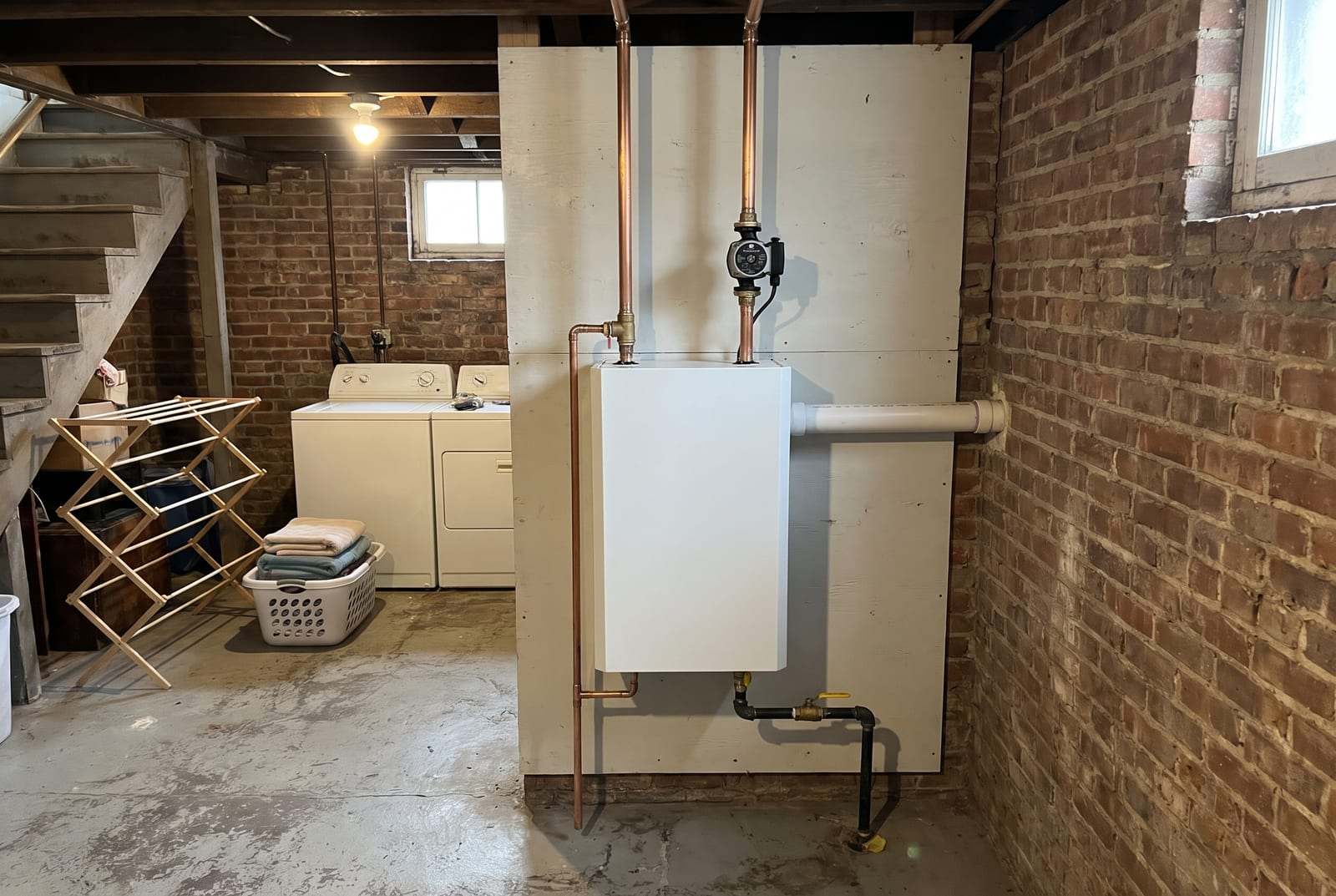
A newer wall-hung condensing boiler adds a furnace-style ignition sequence, a condensate trap and its own fault codes. Steam boilers depend on a low-water cutoff; if the sight glass shows no water, shut the boiler off until it’s checked.
Gas Smell or a Carbon Monoxide Alarm
Leave the house first, then call 911 or the gas utility’s emergency line from outside. Don’t switch anything on or off on the way out, and stay outside until the utility or the fire department says it’s safe.
Before You Book a Repair
- Thermostat: set to Heat, a few degrees above room temperature, with fresh batteries if it uses them.
- Filter: pull it and hold it up to a light. If you can’t see through it, replace it.
- Breaker: find the furnace circuit in the panel and reset it once if it tripped. If it trips again, leave it off.
- Furnace switch: a light switch on or near the furnace, often at the top of the basement stairs, that someone turned off by mistake.
- Model label: inside the front panel or on the side. The model and serial numbers tell a technician the furnace’s age and the parts it uses.
If the furnace is completely off and the house is getting cold, work through the no-heat checks before you call.
Repair or Replace an Older Furnace
What are the signs an older furnace is near the end?
Several different parts failing within a few seasons, rooms that heat less evenly than they used to, a lazy yellow burner flame, rust or soot around the burners, and gas bills that climb while the thermostat setting stays the same. One sign alone rarely decides it; three or four together on a furnace past fifteen years usually do.
What does a cracked heat exchanger mean for my furnace?
The heat exchanger keeps combustion gases apart from the air that moves through the house. A crack can let carbon monoxide into that air, so a furnace with a confirmed crack is shut off and, in most cases, replaced rather than repaired. Soot around the burners, a flame that wavers when the blower starts and high carbon monoxide readings in the supply air are the usual clues.
Is it worth repairing a furnace that keeps breaking down?
Look at what is failing. The same flame sensor coating over every winter points to a cause, such as dirty combustion air or a poor ground, that a repair can fix. Different parts failing one after another on an older unit is the pattern that makes a replacement sized to the house worth comparing against the next repair.
Can an older furnace be made to run more efficiently?
Only up to its rating. Clean burners and a clean flame sensor, a fresh filter, sealed duct joints and the right gas pressure help it reach the efficiency it was built for, but an 80 percent furnace stays an 80 percent furnace.