
Before Your Visit for Heating and Cooling Service
How to get ready for a furnace, boiler, AC or heat pump visit: what to note, what to clear and what to send ahead.
A visit goes best when Lukas Colon knows what the system is doing before he arrives: a rattle, rooms that heat unevenly, a smell when it starts up. Three things help most: a short note on the problem, a clear path to the equipment, and photos of the unit’s label sent ahead by email. The visit starts with finding the part that failed, and good notes get there sooner.
Visit Prep for Your Job
Choose what the visit is for and where the equipment sits, then press Make My List for what to note, what to clear and what usually gets checked first.
Choose the job and the equipment location, then press Make My List.
What Happens at a Heating or Cooling Visit
Most heating and cooling visits in the trade run in the same order, whatever the system.
Arrival and a Few Questions.
Questions about what the system is doing, when it started, and what has been tried already, such as a reset, a new filter or new thermostat batteries.The Equipment and Its History.
The model label, the age of the unit, past repairs and the state of the filter say a lot before any panel comes off.Finding the Fault.
Meter readings at the control board, the igniter, the pressure switch or the capacitor narrow it down until one part explains the symptom.Laying Out the Options.
If one part failed, that part is the repair. If the system is past saving, the choices are a repair to get through the season or a replacement sized to the house.The Repair or the Plan.
A repair goes ahead once the part is in hand. A replacement becomes a plan: the equipment, its size, any ductwork changes and the timing.
A replacement also brings permits, an inspection and a round of final tests, which follow our process for heating and cooling jobs.
Getting the Space Ready
Clear a path to the furnace, the outdoor unit and the thermostat. A technician carries a tool bag, a meter case and sometimes a ladder or a shop vacuum, so a path means about three feet wide. Move boxes, laundry baskets and bikes away from the front of the furnace and the water heater, and leave the furnace’s lower door and the filter slot reachable.
Pets
Keep dogs and cats in a closed room away from the basement and the work area. A furnace with its door off, an outdoor unit with its panel open and a back door propped for tools are no place for a curious pet.
Parking
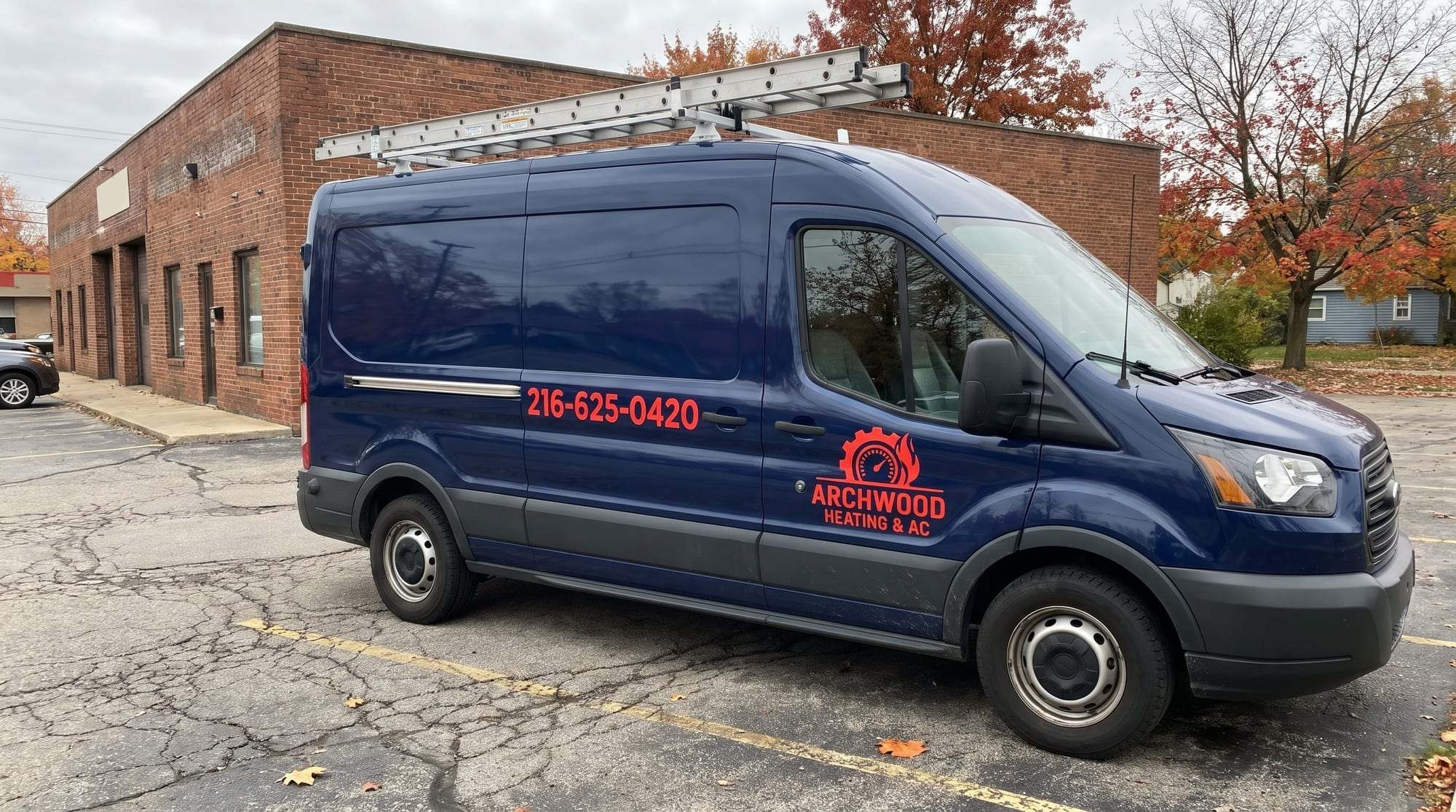
Leave the driveway or a curb space near the door open for the van if you can. On a narrow street of doubles with parking on one side, a spot close to the house means fewer trips through the hall in wet boots.
Photos of the Label by Email
Photos of the unit’s label or the trouble spot, sent ahead to office@archwoodheatingac.com, help Lukas bring the right parts. The label is a metal or paper plate inside the furnace door or on the side of the outdoor unit, with the model and serial numbers; one clear, straight-on photo is enough. For the trouble spot, take a wide shot and a close one: the leak, the ice on the lines, the scorched wire.
Notes on the Problem
Write down what the system does and when: the rattle that starts with the blower, the bedroom that never warms, the smell at startup, the outdoor unit that hums but doesn’t spin. Add when it began and what changed around then, such as a new thermostat, a finished basement or a different filter.
What an HVAC Estimate Covers
What does an HVAC estimate usually cover?
For a repair, it names the failed part, what made it fail, and the work to replace it. For a replacement, it covers the type of system, its size and efficiency, and any changes the ductwork, venting, gas line or wiring will need.
Why does the estimate depend on the diagnosis?
Because the same symptom has very different causes. A furnace that won’t stay lit can have a dirty flame sensor or a cracked heat exchanger, and an AC blowing warm air can have a failed capacitor or a refrigerant leak. The estimate follows the fault, so it can’t be set before the fault is found.
How is the size of a new system worked out?
From the house, not from the old unit’s label. A load calculation such as Manual J looks at floor area, windows, insulation and air leakage, and the ductwork is checked for the airflow it can carry. A unit that’s too large short-cycles and leaves rooms clammy; one too small runs nonstop in a cold snap.
Should I repair an old system or replace it?
It depends on the fault, the age of the equipment and what else is wearing out. A failed igniter on a sound furnace is worth repairing. A cracked heat exchanger or a dead compressor on an old unit usually points toward comparing replacement systems.
Can photos take the place of a visit for an estimate?
Photos help with parts and planning, but a repair estimate rests on the diagnosis, and that takes meters on the equipment. For a replacement, sizing needs the house measured and the ductwork checked in person.